AI Agents Explained: How Businesses Are Replacing Manual Workflows in 2026
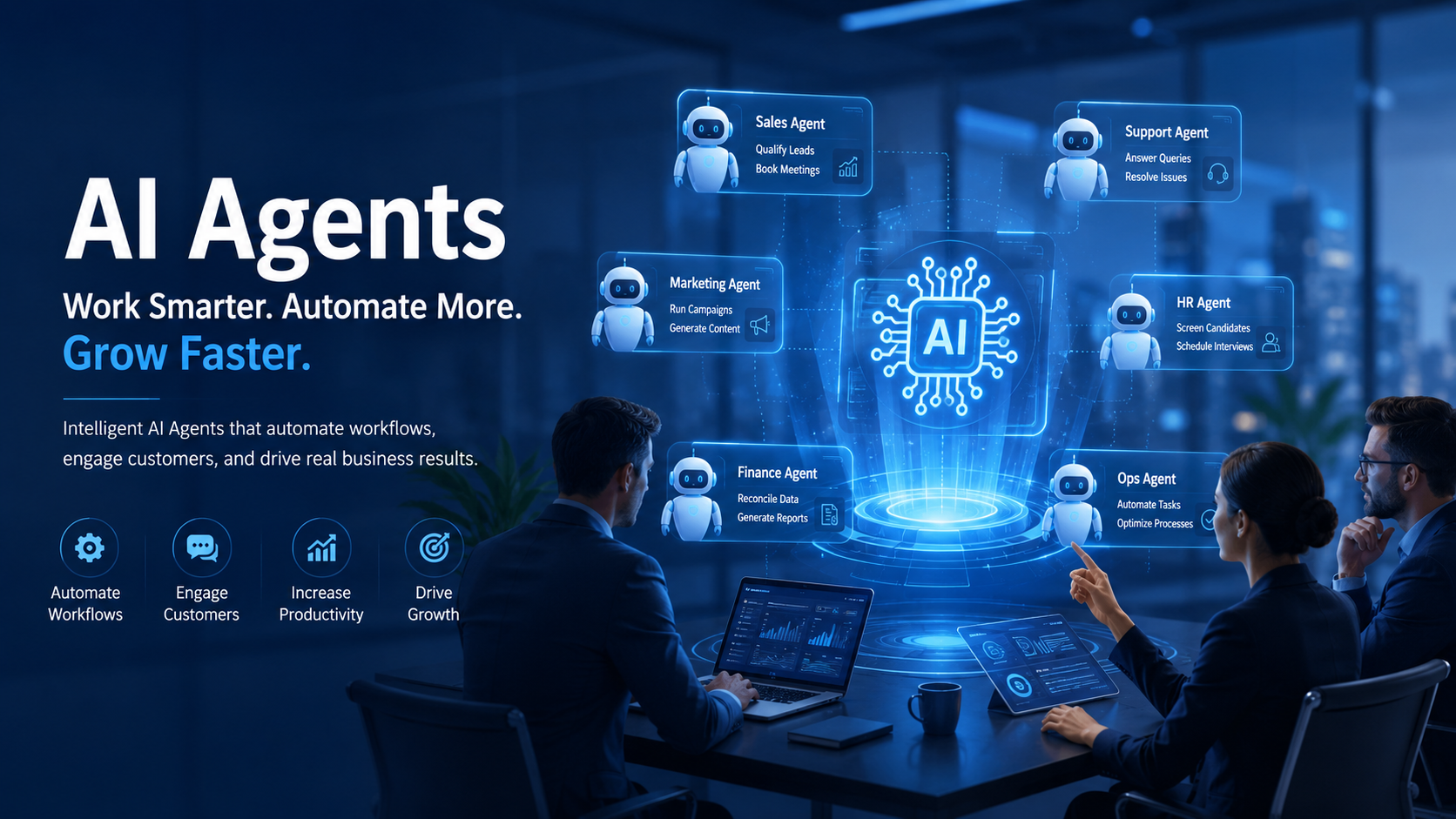
AI Agents Explained: How Businesses Are Replacing Manual Workflows in 2026
Executive Summary
Every growing business eventually faces the same challenge: operational work increases faster than revenue. Teams spend more time responding to customer enquiries, updating CRM records, scheduling meetings, managing documents, routing approvals, and coordinating internal workflows than focusing on activities that directly create business value.
For years, businesses addressed this problem through workflow automation and software integrations. While these solutions improved efficiency, they still depended on employees to make decisions whenever situations changed. In 2026, organizations are moving beyond automation and adopting AI Agents that can understand objectives, make informed decisions, and execute complete business workflows with minimal human intervention.
This guide explains why AI Agents are becoming the foundation of modern business operations, how they differ from traditional automation, where they create measurable business value, and how organizations can successfully adopt them using an enterprise-ready AI Agents Platform.
Key Takeaways
- AI Agents automate complete business workflows instead of isolated repetitive tasks.
- Businesses are using AI Agents across sales, marketing, customer support, HR, finance, healthcare, legal, and operations.
- Unlike traditional automation, AI Agents make contextual decisions rather than following fixed rules.
- Organizations adopting AI Agents improve productivity while reducing operational costs.
- AI Agents are becoming the next layer of enterprise digital transformation.
The Real Business Problem Isn't Manual Work, It's Operational Friction
Most organizations don't struggle because employees lack skills or motivation. They struggle because too much time is consumed by operational friction small repetitive activities that accumulate throughout the day and quietly reduce productivity across every department.
A sales representative manually qualifies inbound leads before booking meetings. Customer support teams repeatedly answer the same questions. Marketing specialists export reports from multiple platforms to measure campaign performance. HR departments coordinate interviews, onboarding, and employee documentation. Finance teams chase approvals while operations teams manually update multiple systems after every customer interaction.
Individually, these tasks appear insignificant. Collectively, they consume hundreds of hours every month, slow business growth, increase operational costs, and limit an organization's ability to scale.
Business Insight
Most companies don't have an automation problem. They have a decision-making problem. Traditional automation handles repetitive actions, but it still relies on people whenever the business context changes. AI Agents bridge that gap by combining reasoning with execution.
This shift explains why enterprise leaders are increasingly viewing AI Agents as operational teammates rather than software tools. Instead of assisting employees with individual tasks, they help organizations redesign how work gets done.
The Enterprise AI Evolution Framework™
Digital transformation has progressed through several stages over the past two decades. Understanding this evolution helps explain why AI Agents represent the next logical step rather than an isolated technology trend.
| Business Stage | Primary Focus | Limitation |
|---|---|---|
| Manual Operations | People perform every task manually. | Slow growth and inconsistent execution. |
| Digital Operations | Business software replaces paperwork. | Employees still complete repetitive work. |
| Workflow Automation | Routine processes become automated. | Cannot adapt to changing situations. |
| AI Assistance | Employees receive recommendations and generated content. | Humans still execute workflows. |
| AI Agents | AI understands goals and executes complete workflows. | Requires governance and enterprise knowledge. |
| Autonomous Enterprise | Multiple AI Agents collaborate across departments. | Emerging business operating model. |
Most organizations currently operate somewhere between workflow automation and AI assistance. The businesses gaining a competitive advantage in 2026 are moving into the AI Agent stage, where intelligent systems execute processes instead of simply supporting them.
Why Traditional Automation Has Reached Its Limits
Workflow automation transformed businesses by eliminating repetitive manual actions. However, automation platforms depend on predefined rules. They perform exceptionally well when every possible scenario has been mapped in advance.
Modern business environments rarely work that way. Customer enquiries vary, internal priorities change, data arrives from multiple systems, and unexpected situations occur every day. Static workflows cannot reason through these variables, forcing employees to step in whenever the process encounters something unfamiliar.
This creates an operational bottleneck where automation handles simple work while people spend their time managing exceptions. As organizations grow, those exceptions grow too, reducing the long-term value of traditional automation.
Enterprise businesses are addressing this challenge by combining intelligent decision-making with workflow execution through an AI Workflow Automation platform. Instead of relying solely on predefined rules, AI Agents interpret context, evaluate available information, and determine the most appropriate action before continuing the workflow automatically.
Quick Example
Imagine a customer asking about enterprise pricing.
A traditional chatbot provides a pricing page.
An AI Agent can identify buying intent, qualify the prospect, retrieve relevant product information, schedule a product demonstration, create a CRM record, notify the sales team, and trigger a personalized follow-up sequence all within the same conversation.
The objective isn't answering the question. The objective is to complete the business workflow.
What Makes AI Agents Different?
Many business leaders use the terms AI Assistant, AI Chatbot, and AI Agent interchangeably. While they share similar technologies, their business capabilities are fundamentally different. Understanding these differences is essential when planning an enterprise AI strategy.
| Capability | AI Chatbot | AI Agent |
|---|---|---|
| Primary Purpose | Answer questions | Complete business objectives |
| Decision Making | Limited | Context-aware |
| Workflow Execution | Minimal | End-to-end |
| Business Integrations | Basic | CRM, ERP, Email, Calendars, Knowledge Base |
| Business Value | Better conversations | Better business outcomes |
Think of it this way: a chatbot communicates with customers, while an AI Agent takes ownership of the work that follows the conversation. This is why many organizations now combine conversational interfaces with an AI Chatbot Platform and an AI Agent operating behind the scenes.
At a Glance
The goal of an AI Chatbot is to improve conversations. The goal of an AI Agent is to improve business operations.
Where AI Agents Create the Greatest Business Value
Organizations achieve the highest return when AI Agents automate repetitive processes that require context, coordination, and consistent execution. Rather than replacing employees, they remove operational bottlenecks that prevent teams from focusing on strategic work.
Sales Operations
Sales teams benefit from AI Agents that qualify leads, update CRM systems, schedule meetings, send follow-up emails, prioritize opportunities, and keep pipelines organised automatically. Instead of manually managing administrative work, representatives spend more time building customer relationships and closing deals.
Marketing
Marketing teams can automate campaign execution, customer segmentation, content distribution, lead nurturing, and reporting. Integrated with an AI Marketing Platform, AI Agents ensure prospects receive timely, personalised engagement throughout the buying journey.
Customer Support
AI Agents retrieve information from enterprise knowledge bases, resolve common enquiries, route complex cases to specialists, and maintain conversation history across channels. Customers receive faster responses while support teams focus on high-value interactions.
Healthcare
Healthcare providers use AI Agents to automate appointment scheduling, patient communication, documentation, reminders, and administrative coordination. Solutions like Healthcare AI Solutions help reduce administrative burden while improving the patient experience.
Legal Services
Legal professionals can streamline document review, case summarisation, research, and client communication through Legal AI Solutions. AI Agents accelerate repetitive work while maintaining consistency across legal processes.
The AI Agent Readiness Checklist™
Not every workflow should be automated immediately. Businesses should begin with processes that are repetitive, measurable, and generate clear operational value.
- ✔ High-volume repetitive work.
- ✔ Clearly defined business outcomes.
- ✔ Existing digital documentation.
- ✔ Integration with CRM or internal systems.
- ✔ Measurable performance indicators.
- ✔ Human oversight available for continuous improvement.
If your organization can confidently check most of these boxes, it is well positioned to begin deploying enterprise AI Agents.
The Future of Business Operations
Over the next few years, organizations won't measure digital maturity by how many software applications they use. They'll measure it by how much work intelligent systems complete independently.
Businesses that continue relying solely on manual workflows will face increasing operational costs and slower response times. Those that embrace AI Agents will build more agile organizations capable of delivering better customer experiences while scaling efficiently.
This shift isn't about replacing employees. It's about allowing people to focus on creativity, strategy, collaboration, and decision-making while intelligent systems manage operational execution.
Ready to Build Intelligent Business Workflows?
Whether your goal is to improve customer support, automate sales processes, streamline marketing operations, or modernize industry-specific workflows, AI Agents provide the foundation for scalable business automation.
Explore how the AI Agents Platform, AI Workflow Automation, and industry-focused AI solutions from AtBridges can help your organization replace manual workflows with intelligent business operations.
Frequently Asked Questions
What is an AI Agent?
An AI Agent is intelligent software capable of understanding goals, making decisions, interacting with business systems, and completing operational workflows with minimal human intervention.
Are AI Agents different from chatbots?
Yes. Chatbots primarily answer questions, while AI Agents execute tasks, automate workflows, and interact with enterprise systems to achieve business objectives.
Which businesses benefit most from AI Agents?
Organizations in SaaS, healthcare, legal, education, retail, financial services, manufacturing, and customer support can significantly improve productivity through AI Agent adoption.
Can AI Agents integrate with existing software?
Yes. Enterprise AI Agents commonly integrate with CRM platforms, ERP systems, email tools, calendars, knowledge bases, and workflow automation platforms, allowing them to execute tasks across multiple business applications.
How do I get started with AI Agents?
Start by identifying repetitive workflows with measurable business outcomes. Then evaluate an enterprise-ready platform that can securely integrate with your existing systems and scale across departments as adoption grows.