Why Lead Management Automation Is Critical for Inbound & Outbound Sales
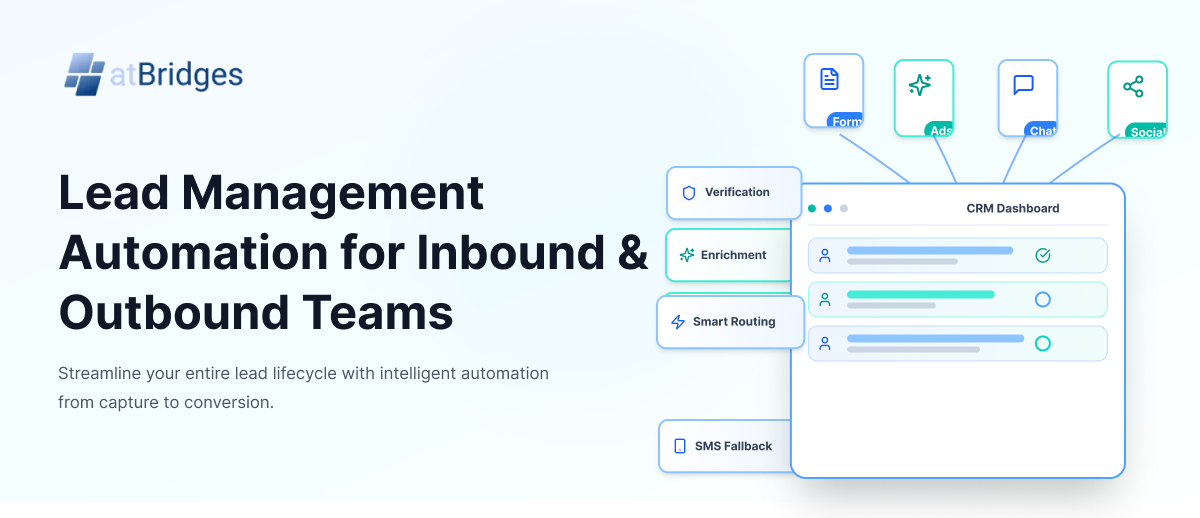
Today, businesses generate more leads than ever before with multiple channels generating leads daily (Websites, Landing Pages, Paid Ads, APIs / Chatbots, Social Media, and Third Party Applications. As a result of the increase in lead volume, however, many companies continue to manage their leads manually.
In doing so, these companies experience delayed / inaccurate responses, data entry errors, missed follow-ups, and ultimately lost revenue. Lead Management Automation streamlines these manual processes by providing automated, intelligent lead management workflows through rules-based automation (Intelligent rule-based workflows that automatically manage the complete lifecycle of a lead).
Lead Management Automation provides both inbound and outbound team functions with a solid, scalable foundation for predictable, sustainable growth.
What Is Lead Management Automation?
Technology-driven workflows designed specifically for Lead Management Automation can be used to capture, validate, enrich, distribute, and cultivate great leads with no user intervention required. Rather than operating in separate silos through tools such as spreadsheets, Lead Management Automation will implement a centralized pipeline from which leads are managed continuously using defined logic and real-time triggers.
The benefits of this type of automated lead management are:
* Quicker response times
* Improved accuracy of the data
* Consistent follow-up
* Improved alignment between marketing and sales
By deploying both CRM lead management and communication workflows along with the ability to validate and enrich data leads, businesses gain full visibility and control over the entire Lead Operations process.
RealTime Lead Capture Across Multiple Channels
Technology-driven workflows designed specifically for Lead Management Automation can be used to capture, validate, enrich, distribute, and cultivate great leads with no user intervention required. Rather than operating in separate silos through tools such as spreadsheets, Lead Management Automation will implement a centralized pipeline from which leads are managed continuously using defined logic and real-time triggers.
The benefits of this type of automated lead management are:
* Quicker response times
* Improved accuracy of the data
* Consistent followup
* Improved alignment between marketing and sales
By deploying both CRM lead management and communication workflows along with the ability to validate and enrich data leads, businesses gain full visibility and control over the entire Lead Operations process.
Email Verification for Clean and Reliable Lead Data
Poor data quality is a major challenge in outbound lead management. Invalid or fake email addresses increase bounce rates, damage sender reputation, and waste sales resources.
Automated email verification validates every email before outreach by checking:
- Syntax and formatting accuracy
- Domain and mail server validity
- Disposable or temporary email detection
- Spam traps and risky addresses
By filtering invalid contacts early, outbound teams work only with verified, reachable leads. This improves deliverability, protects domain reputation, and increases campaign effectiveness.
Failover Communication With SMS Fallback Automation
Even with verified data, communication failures can occur due to spam filters, inbox overload, or server issues. Lead Management Automation prevents breakdowns through failover communication logic.
When an email fails or remains unopened, the system automatically triggers an SMS fallback. This ensures:
- Continuous communication with prospects
- Multichannel engagement
- Higher response and connection rates
By combining email and SMS automation, businesses create resilient communication flows that adapt to real-world delivery challenges.
Automated Lead Enrichment for Better Sales Context
Raw lead data rarely provides enough context for meaningful sales conversations. Automation enriches leads automatically with firmographic and behavioral insights.
Lead enrichment can include:
- Company name, size, and industry
- Job title and decision-making level
- Geographic and regional data
- Engagement and interaction history
With enriched lead profiles, sales teams can personalize outreach, prioritize high-value prospects, and shorten sales cycles especially critical for outbound automation strategies.
Data Validation and Lead Quality Control
Automation is only effective when the data is accurate. Without proper validation, incorrect or duplicate records can pollute CRM systems and reduce operational efficiency.
Automated data validation ensures:
- Mandatory fields are completed
- Standardized formats for contact details
- Duplicate detection and record merging
- Consistent data across systems
Only validated leads are stored and processed, keeping CRM lead management reliable and actionable.
Event-Driven Triggers That Power Smart Workflows
One of the most powerful aspects of Lead Management Automation is event-driven logic. Instead of relying on manual follow-ups, workflows trigger automatically based on real-time actions.
Common event-driven triggers include:
- Form submissions
- Email opens or link clicks
- SMS replies
- Lead score changes
- CRM status updates
Each trigger initiates predefined actions such as lead assignment, followups, record updates, or sales alerts ensuring timely and relevant engagement.
Seamless CRM Synchronization for Sales Alignment
Disconnected systems create data silos and confusion across teams. Automation resolves this by maintaining continuous CRM synchronization throughout the lead lifecycle.
With automated CRM syncing:
- Lead records update in real time
- Sales teams access complete activity histories
- Duplicate entries are reduced
- Pipeline and performance reports remain accurate
This alignment ensures inbound, outbound, and marketing teams operate from a single source of truth.
Benefits of Lead Management Automation for Inbound Teams
Inbound teams rely on speed and relevance. Lead Management Automation helps them:
- Respond instantly to inbound inquiries
- Route leads based on intent and qualification
- Deliver personalized follow-ups automatically
- Reduce manual workload and errors
By automating repetitive tasks, inbound teams focus more on relationship-building and conversions.
Benefits of Lead Management Automation for Outbound Teams
Outbound teams depend on data accuracy and timing. Automation enables them to:
- Work with verified and enriched lead lists
- Reduce wasted outreach on invalid contacts
- Trigger follow-ups based on engagement behavior
- Scale outbound campaigns consistently
This makes outbound lead automation more predictable, efficient, and measurable.
From Reactive Lead Handling to Predictive Sales Automation
Traditional lead management is reactive. Automated systems are predictive. They anticipate actions, trigger workflows instantly, and guide leads through structured journeys.
This shift enables:
- Faster conversion cycles
- Higher engagement rates
- Scalable growth without increasing headcount
- Improved forecasting and revenue visibility
Sales automation transforms lead management into a strategic growth engine rather than an operational bottleneck.
Conclusion
Lead Management Automation is essential for organizations handling high lead volumes across multiple channels. By automating lead capture, verification, enrichment, validation, and follow-ups, businesses create scalable and reliable pipelines for both inbound and outbound teams.
With event-driven workflows and seamless CRM synchronization, every lead is handled accurately and consistently. By moving from manual, reactive processes to automated, predictive systems, businesses gain efficiency, stronger engagement, and longterm revenue growth.